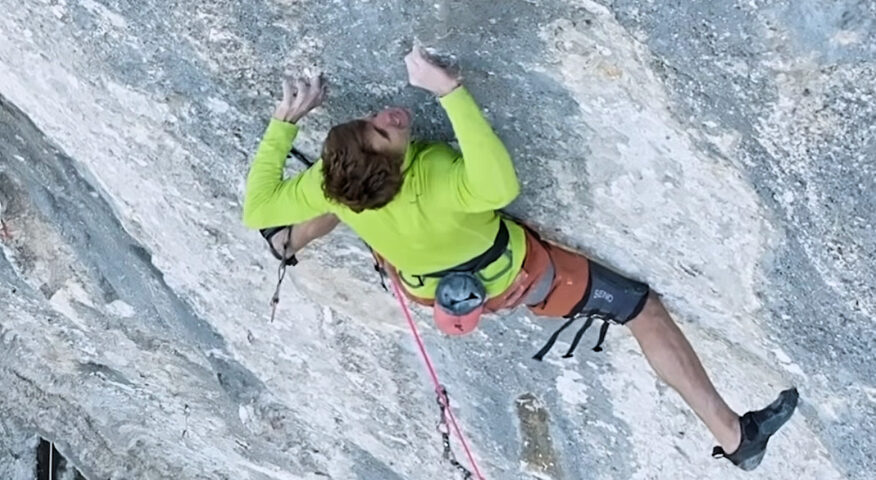
Ed's 16 year long battle ended this past May on Annapurna 1. Moreover, Ed became only number five in the world of of those who have climbed the world's tallest mountains without O2. Image of Ed on the summit of Annapurna, courtesy of Ed Viesturs.
On their pre-acclimatization climb on Cho Oyu, the team decided Ed would help altitude-sick photographer Jimmy Chin down whilst Veikka would continue up, as Ed had already summited Cho Oyu twice. Veikka reached Cho Oyu summit in very windy conditions, and continued to bag Annapurna together with his long time climbing partner Ed Viesturs shortly after. Image of Veikka Gustafsson on the summit of Annapurna, courtesy of Ed Viesturs.
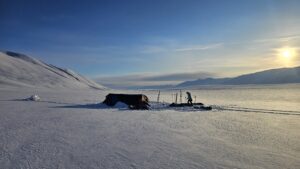
"Climbing to the summit of Everest without supplemental oxygen was a great highlight of my career. But in the end, Annapurna tested me completely - my skills, my judgment and my strength." Ed in camp 2 on Annapurna, courtesy of Ed Viesturs. (Click to enlarge)
"I still work with many of my sponsors. They utilize my experience for design and testing and I still hope to do more of this." Image of Ed Viesturs on Annapurna camp 2, courtesy of Ed.
American Ed Viesturs and Finnish Veikka Gustafsson are long time friends and climbing partners. Veikka has another 4 peaks to go in his own quest for the 14, 8000ers. (Click to enlarge)
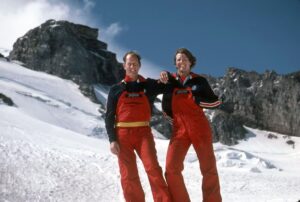
Ed got the news from Veikka, "I almost dropped the phone and was in shock." In 1999, Christian Kuntner found his perfect climbing partner: Abele Blanc. With similar climbing skills and the same attitude towards mountaineering, they were pursuing Annapurna's evasive summit for the third time to finish their last summit in the Fourteen Great ones together, when Christian was killed by a falling serac on May 18. Image of Abele Blanc (left) and Christian Kuntner (right), courtesy of Christiankuntner.com.
Tibetans Rena, Bianba Zaxi and Cering Doje had only G1 and BP left for the complete list of all 14, 8000ers (they had earlier also climbed BP fore summit). They joined forces for Hidden Peak (G1) this summer, when tragedy struck. May 27, the expedition was caught by rockslides, and lost top climber Rena (Ren Na). Bianba Zaxi was severely injured. Image of Rena courtesy of Xinhua.
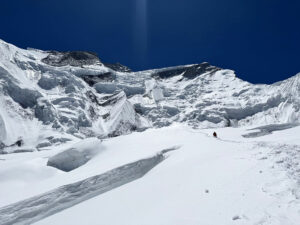
"I am very happy with what I did up to now. I still have a lot to do. No regrets!" Ed Viesturs on the North Face of Annapurna, courtesy of Ed. (Click to enlarge)
LINKS
|
ExWeb interview with Ed Viesturs, part 2: "Now I will need to find new climbing and adventure goals"
Posted: Dec 02, 2005 11:57 am EST
Only twelve men have stood on the summits of the tallest mountains in the world - the 14, 8000ers. The quest takes a lifetime, if not life altogether. Statistics speak a silent message: Out of the 23 aspiring climbers (currently on the 10-13 summits list), 6 have died - 2 only in the past Spring. Out of the twelve lucky ones, only five did them all without supplemental oxygen.
The first from the United States to enter the prestigious list of all 14, 8000ers, is Ed Viesturs. His 16 year long battle ended only this past May on Annapurna 1. Moreover, Ed became number five of those who did it without O2. Yesterday, we talked with Ed about his ultimate climb. Today, part 2 final: About Christian Kuntner, Tomaz Humar, Anna vs. Everest, the money and the future.
ExWeb inteview with Ed Viesturs, part 2 final
ExWeb: You made Everest without oxygen on your third attempt, and you've said it has been your most rewarding climb. Did your final summit of Anna top it?
Ed: Climbing to the summit of Everest without supplemental oxygen is the hardest physical and mental thing I have ever done. It was also quite rewarding to set my mind to doing it and then achieving it. It was a great highlight of my career. But in the end, Annapurna tested me completely - my skills, my judgment and my strength. I don't feel I would have been ready to climb Annapurna at an earlier date in my career. I needed to be smart and know how to do this mountain safely to survive.
ExWeb: 2 other climbers were out on the same mission this year, climbing their last 8000er, on the same mountain and the same route - Abele Blanc and Christian Kuntner. Christian died. It could just as well have been you. When and where did you learn about Christian's death and how did you feel about it?
Ed: Christian and Abele were hit by the avalanche one week after we were on the face. I was already at my home in Seattle when Veikka called me from Kathmandu with the terrible and sad news. I almost dropped the phone and was in shock. Yes it could have been us, but while we were there I felt that the mountain was extremely stable. Perhaps it was luck, perhaps it was something else. I often feel that we had an angel watching over us while we climbed Annapurna. It was sad to lose such a great man as Christian was. We shall all miss him.
ExWeb: Finishing a big goal is a bittersweet moment. In one way it changes life forever, and it's great to have it over with, but about three months later things begin to turn back to normal and there's a void. It's been three months now. Are you lost?
Ed: It is very nice to have this goal accomplished. I feel very satisfied with what I did and very content. But I have always sought difficult and challenging goals and now I will need to find new climbing and adventure goals to set my sights on.
ExWeb: You have mentioned that you'll live a simpler life, and continue climbing but on lower peaks - for fun. Yet there was a reason you went for the 14, 8000ers. Will you really be able to change your core, just like that?
Ed: I chose to climb the 14, 8000ers for the challenge and also because I enjoyed going to very high altitudes. I can be equally satisfied now with lower peaks - there is of course a world of mountains to test oneself on.
ExWeb: American climbers are known to be Everest repeaters. Six time E summiteer, three times without supplementary O2, you have said that the mountain is the only one of the eight thousanders you might return to. Why is that?
Ed: I feel content in having climbed the 14, 8000ers and don't feel the need to do so again. I actually climbed 20, 8000 meter summits over the course of 29 expeditions. I think that is quite enough for now. I have been on Everest several times and always for something interesting and new. There could be the potential for something else interesting on Everest - perhaps more filming projects. Only then would I return to Everest.
ExWeb: You would like to write a book about your climbs to inspire the next generation, and you're spending much time with your kids (Gil, 7, Ella, 4, and Anabel 1). Would you like to see them take up high altitude climbing?
Ed:It has to be their own choice. I will expose them to the outdoors and obviously climbing, but the desire needs to come from them individually. If they choose to climb I would be thrilled. If they do not, I will not be disappointed. We all need to choose our own path in life.
ExWeb: Back to you astonishing accomplishment: Although your own quest took 16 years, many of your fellow climbers died on theirs, and you were the first North American (by far) to achieve it, some American climbers who have not even been close to other 8000ers, or at best, climbed the fixed route on Everest say that "climbing all 14 by the standard routes is no longer important to world climbing." What's your take on that?
Ed: I never set out to do something important for the world of climbing. I did this all for myself and was self motivated. It did not matter to me what people thought of this, as long as I was true to my own values. Most critics usually have no understanding of what they are talking about. Often criticism is based on ignorance or jealousy. Climbing one 8000er successfully without oxygen is quite difficult, let alone climbing all 14 and surviving with your life and no frostbite. Whether people applaud what I did or criticize what I did has no relevance to why I did this. It was my goal and I achieved it.
ExWeb: On the other hand, Tomaz Humar screwed up pretty badly trying to do a new route on the Rupal face, and the same critics (vouching for new routes and alpine styles over altitudes) are ready to jump him for it. What's your take on Humar's attempt and rescue?
Ed: Tomaz is a very talented climber. He was unfortunately caught by bad weather as happens in many mountains of the world. He often chooses very difficult ascent and does them solo. He is pushing the limits and therefore the risks increase. People doing lesser climbs need rescue as well as we all know.
ExWeb: How is your money situation now? Do you make more in design and testing for sponsors, lectures, appearances, promotions, etc. Or will you have to look for a new job soon?
Ed: I still work with many of my sponsors. They utilize my experience for design and testing and I still hope to do more of this. I am also a spokes-person for them while I travel and lecture to the public. I also now have several Ed Viesturs related products - equipment that I have had a hand in designing - the EV2 and the EV3 Mountain Hardware Expedition tents; the Endeavor Series Expedition packs with JanSport; Ed's Choice gloves, mittens and overboots with Outdoor Research, the Timberland approach boot, and Ed Viesturs signature SOLE custom insoles. I am now recently also representing the Thermos company for their new E5 series of products. I also do numerous corporate lectures talking about goal setting, team work and risk management. This is supplemental to working for my sponsors.
ExWeb: On Annapurna, you were excited about the tech you would do together with Cisco and MSN. How do you feel about expedition technology overall? Are you a Luddite like some climbers, or do you like the challenge of tech in exploration?
Ed: "I like to keep the tech at a minimum - usually a hand held sat phone freely supplied by Thuraya and a solar system which I am provided by Brunton. It is very nice to have contact with my wife and children - this was my initial interest in bringing a sat phone starting in the late 90's. Secondarily I could then also do web updates, simply by calling in and having someone at this end transcribe my message. I was able to sell these dispatches to various websites which helped fund my expeditions. I worked initially in the late 90's with Mountainzone.com and the web dispatches were very popular, especially as we made our summit bids. My focus was always on the climb, and if there was time and energy, to make the phone dispatches at the end of the day."
"This year Cisco was an actual sponsor of mine and they also provided some networking product for base camp which they wanted to showcase in this extreme environment. They provided a tech person as well so there was no additional work or distraction for me because of the added technology. MSN had the web dispatch exclusive this year and they did all the work on their end - again, no additional work for me. They had a very rich filled and well produced web cast as a result."
ExWeb: Finally, if you got to live your life all over again. What one single thing you would have changed? ("Nothing" is invalid answer :)
Ed: I am very happy with what I did up to now. I still have a lot to do. No regrets!
On the morning of May 12, ExWeb broke the news: At 2:30 p.m., local time, Ed Viesturs and Veikka Gustafsson had reached the summit of Annapurna with Mario Merelli, Mario Panzeri, and Daniele Bernasconi, after an 11 hour push. The news came over satellite phone from Mario Merelli, relayed to ExWeb by his wife. Silvio Mondinelli did not make it to the summit due to cold. A bitter decision for the great climber, who had been instrumental in fixing ropes and paving the way for the summiteers.
Ed had been rejected by Annapurna twice already, and this season didn't start out great either: First, Ed was forced down on Cho Oyu to help Jimmy Chin who was suffering from AMS. Next, he was pinned down in Camp 3 on Annapurna for two nights, as the jet wind howled above. Two weather forecasts predicted the very high wind to continue; but one offered a glimpse of hope - a temporary decrease in winds!
With the summit, Ed Viesturs became the first American to summit all 14 8000ers - and the 12th climber in the world to accomplish that feat. He is one of only five in the world to have done it without oxygen. Ed has now also completed 20 summits in total on the world's 8000ers (Everest 6 times, Cho Oyu twice). Only Spanish climber Juan Oiarzabal has more; his Annapurna climb made him the sixth climber in the world to bag the 14 eight-thousanders on Earth. His recent K2 summit (2004) gave Juanito the world record of summiting 21, 8000+ peaks.
Ed Viesturs 45, lives in Bainbridge Island, Washington with Wife Paula, and three kids. He has summited 14 of the 14 8000ers, all without oxygen. He has six ascents of Everest, 3 times without supplementary oxygen, and Cho Oyu twice. Last year, Ed summited Everest together with Veikka Gustafsson, David Breashears, Robert Schauer, Jimmy Chin, Amy Bullard and seven climbing Sherpa's. Ed was co-expedition leader (with David Breashears) of an Everest film project for Working Title Films and Universal Pictures.
Originally, Ed wanted to be a veterinarian, "but climbing kept getting in the way, so I quit my job as a vet and started to focus entirely on climbing." He worked as a guide and also a carpenter to pay his bills, and lived cheaply in a friend's basement. Ed's long quest began in Himalaya 16 years ago, starting with Ed's first Himalayan summit - Kangchenjunga - considered by many climbers as the most difficult of the 14, 8000ers. Ed summited the mountain on May 18, 1989 climbing a variation of the British/French (Scott, Boardman, Tasker, Bettembourg) route on the West Face and North ridge.
In 1994, Ed finally set the personal goal for himself to climb the 14, 8000m peaks without oxygen. Although the dream had been born much earlier, ignited by the pages of a book: "As a kid, the book Annapurna inspired me to become a climber. Never did I think that book would have pushed me this far and for this long. It seems appropriate that Annapurna is the final 8000 meter peak."
With this ultimate summit, we asked Ed for an ultimate advice to the new generation of climbers. Here goes:
"Climb for the fun of climbing and do it only for yourself."
|