A repeat of Fram's voyage more than 115 years ago; this winter Tara drifted with the moving ice past the North Pole. (Click to enlarge).
The rounded and flat hull of the 116-foot ship allowed her to remain frozen safely in spite of the extreme pressures applied by the pack-ice.
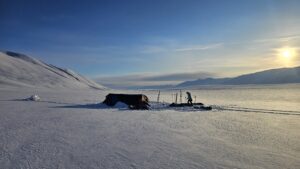
Anchoring Arctic style.
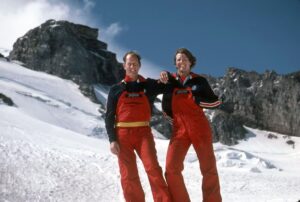
Samuel and Grant before diving under Tara to check the ice and propeller. (Click to enlarge).
"I fulfilled a dream," said Gascard, "I took over this boat to accomplish this drift and it has begun."
End November the crew experienced the most violent storm since the beginning of the expedition. The wind blew up to 100 km/h. (Click to enlarge).
On her 458th day, Tara's main focus was return to sea. With the ice breaking up around her, "we are in the phase of the drift the least well known," the crew reported. (Click to enlarge).
Aurora borealis highlighted a firework of emergency flares sent up to celebrate the ship on arrival.
The crew separated with the two ship dogs, one of which - Zagrey - embarked on a new life of women, meat and rock'n roll.
Image of Tara lit up by Northern lights (click to enlarge).


Best of ExplorersWeb 2008 Awards: Wintering the Big White - Tara's 2007-2008 Arctic Voyage

Posted: Dec 24, 2008 02:19 pm EST
In 1893 Fridtjof Nansen sailed to the Arctic. The plan was for Fram to freeze and drift through the sea ice to the North Pole. One year into the trip it became clear that Fram wouldn't make it. At 84° 4´ Nansen and his friend Hjalmar Johansen left the ship and continued north on foot.

We have covered close to a thousand expeditions in 2008. It's difficult to choose the best, as they all contributed in their own way, sharing their story - their very soul in fact - with us and the world.

And yet, there are those who linger in our minds long after their final debrief. We have chosen 8 expeditions who have contributed in an extraordinary way to the Spirit of Adventure in 2008.

Today number 8: Tara's 2007-2008 Arctic Voyage

A repeat of Fram's voyage more than 115 years ago; this winter Tara drifted with the moving ice past the North Pole, and toward the Northeast side of Greenland. The rounded and flat hull of the 116-foot ship allowed her to remain frozen safely in spite of the extreme pressures applied by the pack-ice.

The voyage took 2 years. As Tara drifted past the North Pole last year, Borge Ousland and Thomas Ulrich retraced the steps of Nansen and Johansen, and brought some well-deserved attention to a little known British Gentleman explorer named Frederik Jackson. The feat won them the 2007 award and this year it's Tara's turn.

Locked in ice

Tara was brainchild of DAMOCLES; coordinated by Jean-Claude Gascard of the University Pierre et Marie Curie in France. The all-volunteer crew of eight males was led by an engineer sailor, two mechanics, a doctor, two science technicians, and two experienced sailors. Most members of the crew were rotated in and out of the ship over time.

Tara left France on July 11, 2006. She met up with Russian icebreaker Kapitan Dranisyn in Tiksi on September 3d. The two vessels headed towards the pack-ice and separated at 80 degrees North latitude, well into the multi-year ice in which Tara would become frozen and drift with the moving ice some 2,800 miles, past the North Pole, through Fram Strait, along the Northeast side of Greenland.

"I fulfilled a dream"

“There are some important things man can do that instruments cannot,” replied by Jean-Claude Gascard to the question why automated scientific buoys were not used instead, comparing the experience of the crew to that of astronauts.

"I fulfilled a dream," said Gascard, "I took over this boat to accomplish this drift and it has begun [but] one must not forget the mission’s objective: to develop an observation and long term prediction system of the Arctic Ice Sea so as to evaluate and predict the climate changes impacts and risks for our planet."

Drinking water was made from wind blown snow, slowly melted into salt free water. Washing water was hacked from low-salt old ice, collected from pressure ridges and hauled to the ship on sleds for melting.

A fixed base for instruments around the ship had to be abandoned due to breaking ice - the scientific preps had to be made from scratch each time in the bitter old and eternal darkness of Arctic winter.

As Tara left the cold Arctic basin meeting the warmer Atlantic water, the men dove under the boat for an evaluation of the ice and Tara's aluminum hull, which fared surprisingly well.

Exit

Exit was the hardest part. "The tales of the Fram Strait descent are very rare, nearly non existent, so we are in the phase of the drift the least well known," the crew reported. The fast drift made for sudden ice formations and ice openings, dotted with icebergs of several thousand tons.

Following her drift in Fram strait to exit the Arctic Ocean; on January 24,2008, Tara touched land in Longyearbyen harbor (Spitsbergen) for the first time in more than 500 days.

On landfall, the perpetual night and aurora borealis ruling over 78°North at this time of the year highlighted a firework of emergency flares sent up to celebrate the ship. The day also marked expedition leader Grant Redvers' 35th birthday; and the end of the year and a half since he last set foot on land.

Separation and return of sun

The crew separated with the two ship dogs, one of which - Zagrey - embarked on a new life of women, meat and rock'n roll; to be used for breeding at a local kennel as few of his kind are found in Spitzbergen.

"It's like losing a friend," said Captain Herve Bourmaud. "After all the months we've shared on the ice we noticed how adapted these dogs are to the polar areas. To separate from them is like leaving expedition members behind."

Ahead for Tara was a new ocean, free from ice - and the sun - which some of the crew members met again for the first time since mid-October 2007.

In addition to commemorating the amazing accomplishments of past explorers such as Nansen and Johansen; Tara provided scientists with a cross section of physical and biological parameters across the Arctic.

Gascard hopes that the results “will be used as a resource in Arctic science research,” and he notes that the data will not be protected, but will be available to all scientists for use in their own research.

Related story: Best of ExplorersWeb 2007 Awards: Thomas and Borge - in Nansen's footsteps, North Pole

Previous in the countdown:

Special mention:

North Pole explorers Matvey Shparo and Boris Smolin
B.A.S.E. jumper Valery Rozov
Everest seniors Yuichiro Miura and Min Bahadur Sherchan
James Burwick and the Anasazi girl


EVEREST K2 LATEST NEWS
EVEREST K2 FEATURE ARTICLES
INTERVIEWS
EDITOR'S CHOICE
CLASSIC